Friction is the Enemy: Why Your Parts are Failing and How Superior Plating Fixes Them
If you’re an OEM, you know the drill. You design a perfect component, it looks great on the CAD screen, but three months into field testing, it’s galling, seizing, or just wearing down into expensive dust.
Usually, the culprit is simple: friction.
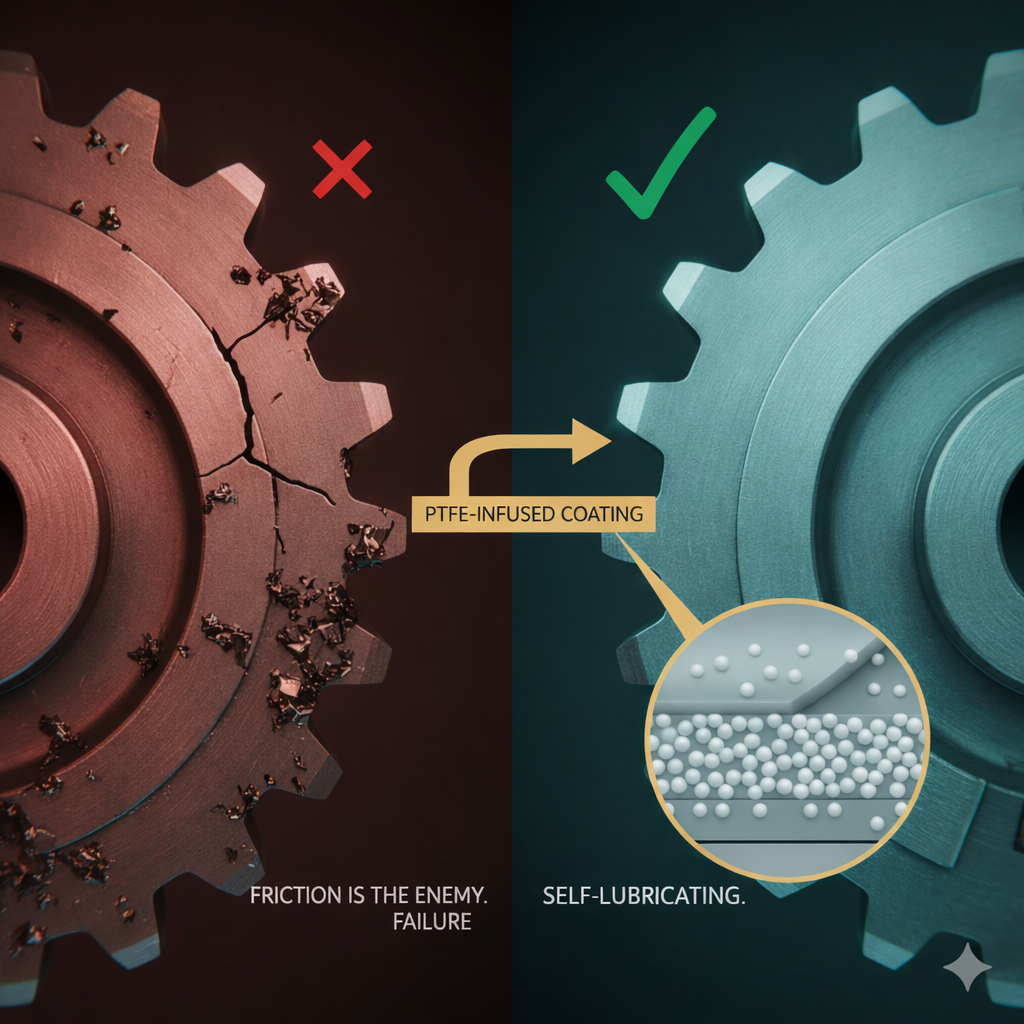
Most people try to solve this with grease. But grease is messy, it attracts grit, and eventually, it fails. That’s where our high performance electroless nickel composites come in. They’re not just coatings; they basically give your metal parts a permanent, built-in “self-lubricating” skin.
What’s Actually Happening in the Tank?
We aren’t just painting stuff here. This is a chemical reaction.
We take electroless nickel—which is already tough as nails and highly corrosion-resistant—and we co-deposit microscopic particles of PTFE (you probably know it as Teflon™) or Boron-Nitride throughout the entire layer.
This isn’t some cosmetic treatment on the surface. Whether you select Pen-Tuf® (EN with PTFE) or BNEN (boron-nitride electroless nickel), as the surface of your parts are subjected to wear, new particulate is exposed. These are deposits are “self-renewing” sources of low friction.
Why This Beats Standard “Dry Lubes”
- Uniformity is everything: Unlike spray-on coatings that may pool in corners or confound tight tolerances, electroless nickel is the engineer’s friend. The thickness is controllable to +/- 0.0001″ so, whether it’s a tiny internal thread or a tight outside diameter, the thickness is uniform everywhere. No “thick spots” to mess up your assembly.
- The “Non-Stick” Reality: We’re talking about a coefficient of friction under 0.2. That is incredibly slippery. BNEN and Pen-Tuf® reduce stiction and, as an example, stop “stick-slip” (that jerky movement in actuators) dead in its tracks.
- Hard + Slippery: Usually, you get one or the other. Hard chrome is hard but brittle. Plastic is slippery but weak. Composite plating gives you the essential backbone of nickel with the “slide” of a polymer.
Real-World Wins: Where This Actually Matters
We’ve plated parts in industries where failure isn’t an option. For example:
1. Molding Machinery: If you’re running an injection machine, the last thing you need is for the formed part to stick to the mold or for the mold to fail to open. Our coating allows those sliding parts to run “dry” while improving manufacturing operations.
2. Aerospace Components: Prevent galling, reduce stiction and ensure that parts can operate smoothly and be easily disassembled for maintenance. Those bolts need to be able to turn!
3. Internal Firearms Parts: Safe, smooth operation of firearms requires parts that properly function. Sticky triggers cannot be accepted.
The Bottom Line for OEMs
If you’re tired of warranty claims and “it seized up” emails from customers, you need to look at the surface science. Our proprietary blends offer you the options that keep your machines running when the “cheap” coatings have already flaked off.
Stop fighting friction. Just outsmart it.