Low, Mid or High Phosphorus Electroless Nickel: How to Choose the Right Spec
“Electroless nickel per AMS 2404” is one of the most common notes we see on aerospace prints. It is also one of the least specific. Electroless nickel (EN) is not a single coating. It is a nickel-phosphorus alloy, and the amount of phosphorus in the deposit changes how hard it is, how well it resists corrosion, whether it is magnetic, and how it behaves after heat treatment.
If you are an engineer writing a specification or a buyer sending parts out for plating, knowing the difference between low, mid and high phosphorus EN helps you get the part you actually need, the first time.
What “Phosphorus Content” Means
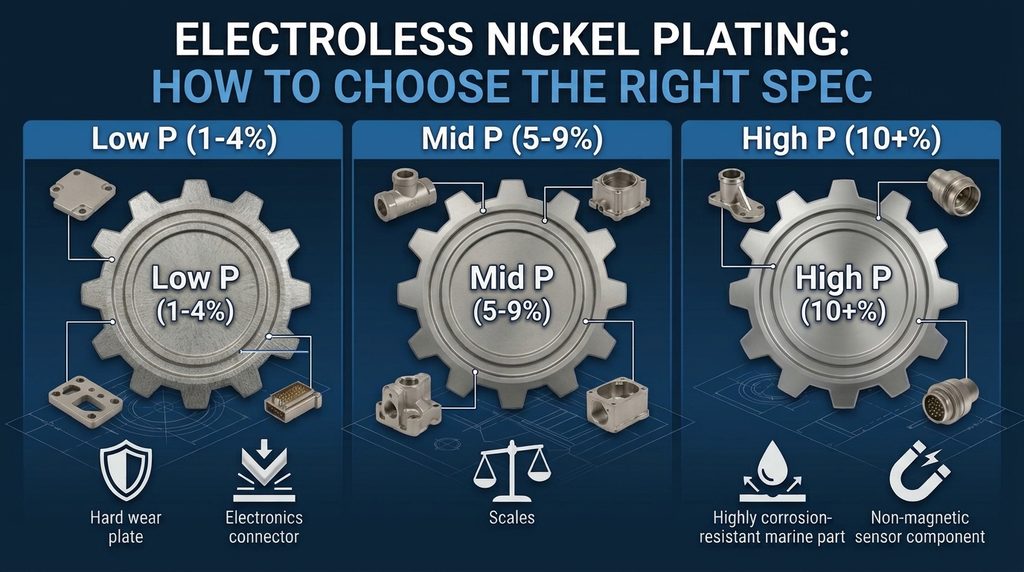
Electroless nickel is deposited by a chemical reaction rather than electric current, usually with sodium hypophosphite as the catalyst. The reaction co-deposits phosphorus with the nickel, so the finished coating is an alloy. The plating chemistry controls how much phosphorus ends up in the deposit, and the industry groups coatings into three general ranges:
- Low phosphorus: roughly 1 to 4% P
- Mid (medium) phosphorus: roughly 5 to 9% P
- High phosphorus: roughly 10+% P
ASTM B733 notes that the chemical and physical properties of the deposit vary primarily with its phosphorus content and any heat treatment that follows. In general, as phosphorus goes up, corrosion resistance goes up and as-plated hardness goes down.
Low Phosphorus Electroless Nickel (1% to 4% P)
Low phosphorus deposits are microcrystalline. They have the highest as-plated hardness of the three, which ASTM B733 puts at roughly 620 to 750 HK100 for the 1% to 4% range. That makes them a good fit for abrasion and wear applications where you do not want to heat treat the part.
The lowest phosphorus deposits (about 1% to 3%) are used in electronics for solderability, wire bondability and electrical conductivity. Low phosphorus EN also resists strong alkaline environments better than higher phosphorus coatings.
The tradeoffs: lower corrosion resistance in acidic and salt environments, and the deposit is magnetic.
Typical uses: wear surfaces, tooling, molds, electronic components needing solderability, parts exposed to caustic solutions.
Mid Phosphorus Electroless Nickel (about 5% to 9% P)
Mid phosphorus is the general-purpose workhorse. ASTM B733 describes medium phosphorus coatings (5% to 9% P) as the most widely used for general wear and corrosion requirements. It offers a balanced combination of hardness, corrosion protection, bright appearance and cost.
As plated, mid phosphorus EN is moderately hard, and it responds well to heat treatment. It is weakly magnetic as deposited.
Typical uses: general machined components, hydraulic and pneumatic parts, valves, fittings, housings and most parts where the drawing simply says “electroless nickel.”
High Phosphorus Electroless Nickel (about 10% P and above)
High phosphorus deposits are amorphous rather than crystalline, which gives them the best corrosion resistance of the three. ASTM B733 notes their superior salt spray and acid resistance. They also tend to have lower internal stress.
They are softer as plated, but can still be hardened by heat treatment. One major advantage is non-magnetism: ASTM B733 states that coatings above 11.2% phosphorus are not considered ferromagnetic. That makes high phosphorus EN a common choice for components near sensors, electronics and other magnetically sensitive equipment.
Typical uses: oil and gas, chemical processing, marine and aerospace parts in corrosive service, non-magnetic requirements, and parts made of materials such as beryllium and titanium where low stress matters.
What Heat Treatment Does
All three types can be heat treated to increase hardness. Heating causes nickel phosphide to precipitate in the deposit, and post-plate treatments around 400 C (750 F) can push hardness to roughly 850 to 1,000+ HK. ASTM B733 Class 2 heat treatment (260 to 400 C) requires a minimum hardness of 850 HK100.
The catch is that hardening heat treatment reduces the corrosion resistance of the coating, especially for high phosphorus deposits, and makes higher phosphorus deposits magnetic. If you need both maximum hardness and maximum corrosion protection, talk to your plater before finalizing the callout.
Lower-temperature bakes, such as hydrogen embrittlement relief for high strength steel or adhesion bakes for aluminum and titanium, are different from hardening heat treatments. Specs like ASTM B733 assign them separate classes, so make sure the drawing says which one you want.
Comparison Table
| Property | Low P (1-4%) | Mid P (5-9%) | High P (10+%) |
|---|---|---|---|
| Structure | Microcrystalline | Mixed | Amorphous |
| As-plated hardness | Highest (about 620-750 HK100) | Moderate | Lowest |
| Hardness after heat treat | Very high | Very high | Very high |
| Wear resistance as plated | Excellent | Good | Fair to good |
| Corrosion resistance (salt, acid) | Fair | Good | Excellent |
| Alkaline resistance | Excellent | Good | Good |
| Magnetic as plated | Yes | Weakly | No (above about 11.2% P) |
| Solderability | Excellent | Good | Good |
| Typical uses | Wear parts, electronics, caustic service | General engineering parts | Corrosive service, non-magnetic parts |
Values are typical ranges. Actual properties depend on bath chemistry, substrate, thickness and post-plate treatment.
Common Electroless Nickel Specifications
Several specs cover electroless nickel. The four you will see most often on aerospace, defense and commercial drawings are:
- ASTM B733: Uses Types for phosphorus content (Type I no requirement, Type II 1-3%, Type III 2-4%, Type IV 5-9%, Type V 10% and above), Service Conditions (SC0 through SC4) for minimum thickness, and Classes for post-plate heat treatment.
- AMS 2404: A widely used aerospace spec for electroless nickel plating. It covers deposit requirements, thickness and heat treatment.
- AMS-C-26074 (formerly MIL-C-26074): Uses Classes to define post-plate heat treatment and substrate condition, and Grades to define thickness.
- MIL-DTL-32119: A military specification for electroless nickel that also defines phosphorus types. Check the current revision for its exact type and class definitions.
A spec alone does not always set phosphorus content. “Per AMS 2404” or “per ASTM B733 Type I” leaves the phosphorus level up to the plater. If phosphorus matters for your part, say so.
How to Call It Out on a Print
A complete callout answers four questions: which spec, what phosphorus range, how thick and what post-plate treatment. For example:
ELECTROLESS NICKEL PER ASTM B733, TYPE V (10% P MIN), SC2 (0.0005 IN MIN), CLASS 1.
ELECTROLESS NICKEL PER AMS-C-26074, CLASS 2, GRADE B.
A few tips:
- State thickness and tolerance. EN builds up evenly on all surfaces, including bores and threads, so account for it in your dimensions and note whether dimensions apply before or after plating.
- Identify masked areas. Call out any surfaces, threads or holes that must stay bare.
- Specify hydrogen embrittlement relief for high strength steels.
- Note special requirements such as non-magnetic, solderable, or a cosmetic appearance.
- Ask for certifications if you need a cert of conformance or phosphorus verification.
Not Sure Which Spec Fits? Send Us Your Print
Advanced Surface Technologies has been plating since 1967 and is the largest electroless nickel plater in Colorado, with five substrate-specific EN lines. AST is ITAR registered, Nadcap accredited for Chemical Processing and its Aerospace Quality System, and approved to ISO 9001. AST works with OEMs, aerospace and defense contractors, and high-end machine shops that have demanding requirements. AST’s process and specification list includes mid phosphorus and high phosphorus electroless nickel to AMS-C-26074, AMS 2404 and ASTM B733.
Learn more about our electroless nickel plating services, or send us your print. We’ll review your application and recommend the right phosphorus level, thickness and heat treatment before your parts ever hit the tank.
Prefer to talk it through? Call (303) 432-8500 or email sales@astfinishing.com.